
Abstract
Mold surface finish is a key factor influencing the appearance, demolding performance, surface gloss, and production yield of injection-molded plastic parts. In modern mold manufacturing and international injection molding projects, three major surface finish systems are widely used: the SPI polishing standard from North America, the VDI 3400 EDM texture standard from Europe, and Mold-Tech (MT) , a commercial system for chemical etching textures. Although all three standards specify mold surface finishes, they differ considerably in processing methods, texture characteristics, roughness ranges, demolding requirements, and typical applications. Incorrectly treating these standards as equivalent or selecting an unsuitable finish can result in engineering disputes, cosmetic defects, and costly mold modifications. This paper reviews the definitions, classifications, technical requirements, and applications of these three systems, compares their roles in mold design and mass production, and outlines practical principles for selecting surface finishes in industrial injection mold development.
1. Introduction
With ongoing developments in consumer electronics, home appliances, and automotive interior products, surface roughness (Ra) alone is no longer sufficient to describe the appearance of molded plastic parts accurately. Surfaces with the same Ra value can look quite different depending on whether they are produced by manual polishing, electrical discharge machining, or chemical etching. SPI, VDI 3400, and Mold-Tech (MT) provide comprehensive systems for specifying mold surface finishes, with defined processing methods, visual reference samples, and clear engineering requirements.
SPI is primarily used in North American projects and covers both mirror-polished and matte finishes. VDI 3400 is widely adopted in European industries, particularly German automotive manufacturing and industrial equipment, where consistent EDM matte textures are required. Mold-Tech (MT), meanwhile, offers a commercial texture library featuring decorative patterns such as fine grain, leather grain, and wood grain. Understanding the differences between these systems helps engineers specify mold finishes accurately and prevent customer complaints in international projects.
2. SPI Mold Surface Polishing Standard
SPI refers to the Society of the Plastics Industry surface finish standard. It divides mold finishes into four categories:
| Class | Process | Typical Applications |
|---|---|---|
| Class A | Diamond polishing | Optical lenses, high-gloss cosmetic housings |
| Class B | Sandpaper polishing | Consumer electronics, appliance housings |
| Class C | Stone finishing | Functional parts, interior surfaces |
| Class D | Blasting finish | Matte functional surfaces |
Each category has three grades (e.g., A1, A2, A3), covering a range of surface appearances from high-gloss mirrors to rough matte finishes produced by blasting.
Class A — Diamond Polishing
SPI Class A covers ultra-high-gloss mirror finishes achieved with diamond paste. A1 represents the highest level of mirror finish, with extremely low surface roughness, suitable for transparent optical components and high-end cosmetic housings. Achieving this finish requires high-hardness, corrosion-resistant mold steel and precise polishing control to eliminate minor scratches and orange peel defects.
Class B — Sandpaper Polishing
Class B is commonly used for consumer electronics, offering a practical balance between gloss and the ability to conceal minor surface imperfections.
Class C & D — Stone and Blast Finishes
Classes C and D are generally applied to functional surfaces where appearance is less critical, helping mask machining marks and shrinkage-related defects.
Key Characteristics
The defining feature of the SPI standard is that its grades are determined by the polishing process rather than roughness values alone. SPI finishes have smooth, continuous surfaces without irregular pits or decorative patterns. However, the standard offers limited options for decorative textures and is therefore best suited to glossy finishes and simple matte appearances.
Design Note: Mold design must incorporate suitable draft angles to prevent vacuum adhesion and surface scratches during demolding, particularly with Class A mirror finishes.
3. VDI 3400 EDM Texture Standard
VDI 3400 is a well-established mold surface finish standard developed by the Association of German Engineers (Verein Deutscher Ingenieure) . It uses electrical discharge machining (EDM) to create uniform, randomly distributed pits on the steel surface. The standard covers grades from VDI 12 to VDI 45, with higher numbers indicating coarser textures and higher Ra values.
EDM Texture Characteristics
Unlike manually polished surfaces, VDI textures are created through spark erosion, resulting in a fine, consistent matte appearance without a distinct directional pattern. This uniform finish is widely used in European industrial design and automotive structural components.
| Grade | Appearance | Common Applications |
|---|---|---|
| VDI 12 | Very fine matte | Precision parts |
| VDI 18 | Fine matte | Consumer electronics, appliance housings |
| VDI 21 | Medium matte | Automotive interior panels |
| VDI 24 | Medium-coarse matte | Structural components |
| VDI 30–45 | Coarse texture | Functional surfaces, grip areas |
VDI 18, VDI 21, and VDI 24 are common choices for mass production, providing a moderate matte effect without an overly pronounced grain texture.
Draft Angle Requirements
Draft angle selection is a major consideration when designing molds with VDI 3400 textures. As the texture becomes deeper, demolding resistance increases significantly:
- Fine VDI textures (12–18): Minimum draft angle 1°
- Medium textures (21–30): Minimum draft angle 1.5°
- Coarse textures (33–45): Draft angle 2° or greater
For glass-fiber-reinforced materials such as PA66+GF and PBT+GF, larger draft angles may be necessary to prevent whitening and scratching on molded surfaces.
Important Limitation: VDI 3400 produces randomly distributed concave pits rather than regular decorative patterns. It cannot reproduce designs such as leather grain or geometric textures and should not be used as a direct substitute for decorative chemical etching.
4. Mold-Tech (MT) Chemical Etching Texture Standard
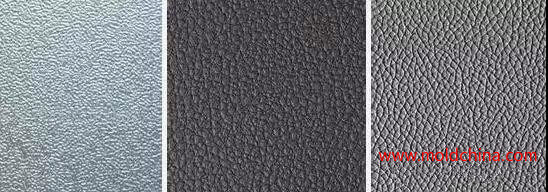
Mold-Tech (MT, aka Mold Texture) is a commercial texture system owned by Standex Engraving. Unlike SPI and VDI, which provide standardized approaches to specifying surface finishes, MT offers an extensive proprietary library containing tens of thousands of designated texture patterns. Each MT number identifies a specific decorative texture style.
MT11000 Fine-Grain Series
One widely used group is the MT11000 fine-grain series. MT11010, for example, is a common choice for the fine matte finishes used on notebook computers, remote controls, and home appliance housings.
Processing Methods
MT textures are produced through chemical etching or laser engraving. The selected pattern is transferred to the mold cavity surface to create a defined, continuous texture.
Demolding Considerations
Texture depth is a major engineering consideration for MT finishes, particularly because of its effect on demolding. Compared with VDI EDM pits, chemically etched textures can have more pronounced 3D peaks and valleys, leading to greater friction during demolding.
- Deep MT textures: Require draft angles of 1.5° to 2°
- Insufficient draft angle: May cause surface tearing and whitening during mass production
Quality Acceptance
MT textures cannot be directly matched to other finishes based on Ra values alone. Final acceptance should be based on the official Mold-Tech reference sample plate. Different plastics, including ABS, PC, TPE, and reinforced nylon, can exhibit different texture depths and gloss levels after molding. Sample approval before mold development is therefore essential.
5. Comparison and Selection Principles for the Three Standards
SPI, VDI 3400, and Mold-Tech (MT) each have distinct application areas:
| Standard | Origin | Method | Best For | Draft Angle |
|---|---|---|---|---|
| SPI | North America | Polishing / Blasting | High-gloss, smooth matte | ≥1° (mirror: ≥2°) |
| VDI 3400 | Europe (Germany) | EDM spark erosion | Uniform matte, industrial | 1°–2°+ |
| Mold-Tech | Global (commercial) | Chemical etching / Laser | Decorative textures, leather grain | 1.5°–2°+ |
Common Engineering Mistake
A frequent mistake is to assume that VDI grades and MT textures are equivalent simply because their Ra values are similar. EDM creates random pits, whereas chemical etching produces defined decorative patterns. These differences affect light reflection and the visual appearance of the finished part, potentially leading to customer rejection during formal project approval.
Material Compatibility
Surface finish selection must also take mold steel, draft angle, and plastic material into account:
- High-gloss SPI finishes: Require steel grades capable of achieving and maintaining a high-quality polish
- VDI textures: Compatible with most mold steels suitable for EDM processing
- MT chemical etching: Requires a uniform and consistent steel structure to prevent uneven corrosion and surface defects
6. Conclusion
SPI, VDI 3400, and Mold-Tech (MT) are distinct mold surface finish systems, each serving a specific purpose:
- SPI classifies polished finishes by gloss and polishing process
- VDI 3400 provides standardized matte textures produced by EDM
- Mold-Tech (MT) offers a wide selection of decorative etching patterns
A clear understanding of their processing characteristics, draft angle requirements, and application limits helps engineers avoid design errors, reduce mold modifications, and maintain consistent appearance and stable production quality in injection-molded parts. In international mold manufacturing and trade, choosing the appropriate surface finish and confirming it against the correct reference sample are essential to developing high-quality molds.